


Yin & Yang
Yin & Yang the dualistic view of the world. Simple and yet diverse because everything is constantly in flux. But the dynamic always leads back to balance. The following is a brief explanation of the concept of Yin & Yang.
Contents
Yin & Yang - shadow and sunny side of the mountain
In traditional Chinese science, yin and yang are also referred to simply as the shadow and sun sides of a mountain. But many other meanings follow.
The first philosophical definition goes back to the scholar Zou Yan (4th century BC) - the founder of the Yin-Yang school and the school of the 5 phases of transformation. Both concepts are inextricably linked in the traditional Chinese world view.
The concept of Yin & Yang
The concept of yin and yang is a fundamental principle in traditional Chinese philosophy, particularly in Daoist and Confucian thought. It represents a dualistic view of the world in which opposites and polarities are in a constant dynamic balance. Yin and yang are interconnected and complementary forces that represent different aspects of life and nature.
Here are some key features of the concept of yin and yang:
1. polarity: Yin and yang are opposites that complement each other. Yin is often associated with dark, passive, feminine, cold and negative, while yang is associated with light, active, masculine, warm and positive. However, these terms are relative and can change depending on the context.
2. reciprocity: Yin and yang are not static, but dynamic. They are in a constant process of change and balance with each other. If one predominates, an imbalance arises that will balance out in the direction of the other.
3. interdependence: Yin and yang cannot exist independently. They only exist in relation to each other. For example, there can be no understanding of lightness without darkness.
4th cycleThe concept of yin and yang is often represented by a circle or a wheel to illustrate the constant change and return of opposites. This symbolizes the cyclical nature of life and nature.
5. applicability: Yin and yang apply to many aspects of life, including health (TCM uses the concept to explain the state of the body), relationships (e.g. male-female dynamics), natural phenomena (day-night cycle) and ethics (balance between virtue and indulgence).
6. harmony and balance: An important goal in the application of yin and yang is to achieve harmony and balance. Ideally, one strives to keep the two forces in a balanced relationship in order to lead a healthy and fulfilling life.
The concept of yin and yang is a profound idea that goes far beyond Chinese philosophy and has found influence in many cultures and disciplines. It contributes to a holistic view of the world and emphasizes the need to accept and respect the dualities and opposites in life in order to achieve balance and well-being.
The creation of the world according to the concept of Yin & Yang
The origin of the world can be explained in TCW with the help of the concept of Yin & Yang.
By the way... many more advantages are waiting for you!
The origin of the world can be explained in TCW with the help of the concept of Yin & Yang:
When taiji moves, it produces yang. When the movement has reached its utmost, then stagnation arises. When stagnation arises, yin is produced. When stillness has reached its utmost, then movement arises again. Stillness and movement are mutually dependent. Yang changes and Yin joins together to create water, wood, fire, earth and metal. The 5 Qi correspond to the Taiji in which the four seasons move. The 5 phases of transformation are a yin and yang, a taiji. The Dao of the hexagram Heaven generates the masculine, the Dao of the hexagram Earth generates the feminine. The two Qi of Yin and Yang react with each other and result in the 10,000 beings that "generate life". The 10,000 beings generate themselves again and again and change without end.
The description of Yin & Yang
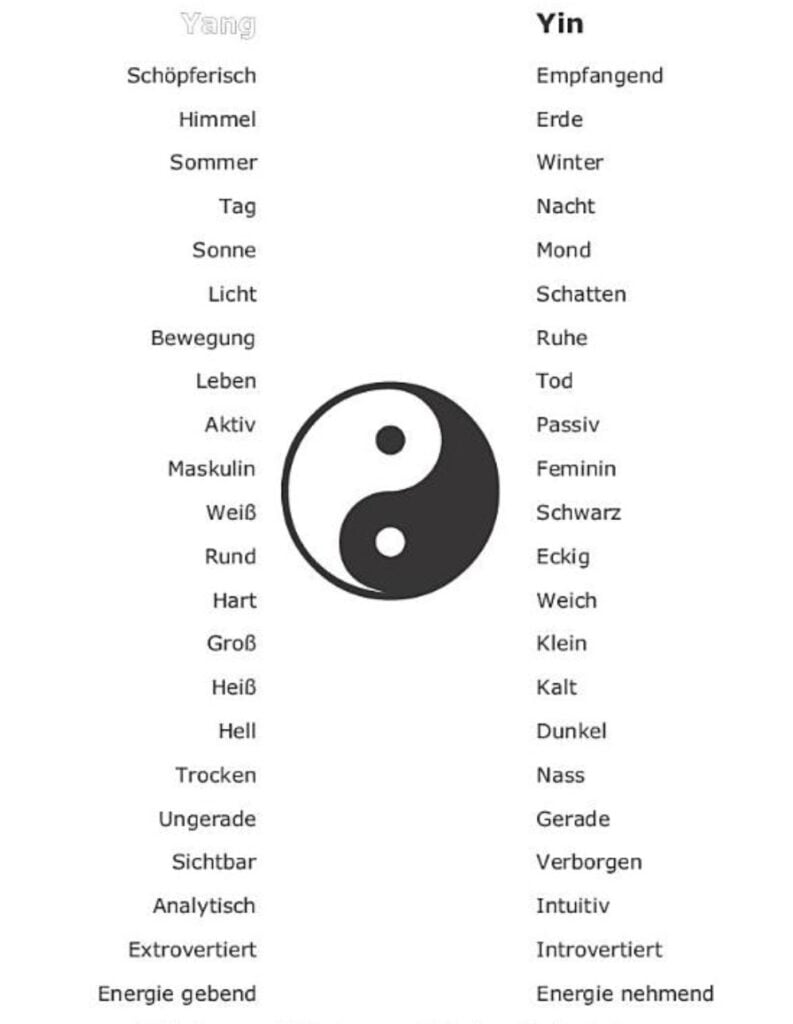
Yin & Yang symbolize duality. The interplay of polarities creates movement and calm - vitality.
Extremes (Yin or Yang) are not conducive! The aim is to achieve a balance between the two states.
In addition to the "shadow side of a mountain", yin represents the feminine, the moist, the receding, the unmoving, ... and is seen as the end of a process. Yang is seen as the "sunny side of a mountain" and with the masculine, the hot and dry, the moving, ... and the beginning of a process.
Yin & Yang - Bedeutung im Bazi Suanming
Im Bazi Suanming repräsentiert das Yang den Beginn einer Wandlungsphase und das Yin den Beendigung. Yin und Yang sind zwei Zustände, die das Qi beschreiben und in der Vereinigung von beiden die Quelle eines Lebenslaufes darstellen. Die 5 Wandlungsphasen beschreiben die äußere Gestalt des Lebenslaufes.
Yin & Yang - Meaning in Feng Shui
In feng shui, the relationship between yin and yang is analyzed in different ways:
- Course of the sun / light & shadow, light & dark
- Thermal / Warm & Cold
- Room sequence / Large & small
- Movement /fast & slow, dynamic & calm
- Frequency / Often & Rarely
The aim is always to create harmony.
It expresses itself in bringing colors, materials, shapes - basically everything that surrounds people - into a balanced relationship. But it is a dynamic balance. Absolute balance would mean stagnation.

