Fir essential oil
Element - Metal
Property - refreshing
Note - Heart
Group - Essential oil
Synonym - Siberian fir
Botanical name - Abies sibirica
Plant family - Pinaceae (pine family)
Contents
Botany
Botanical name
Abies sibirica
Plant family
Pinaceae (pine family)
The pine family (bot. Pinaceae) belongs to the order Coniferales (conifers). As vascular plants, the pines belong to the seed plants (Spermatophytina) within the Coniferopsida class. Pine plants usually present themselves as stately trees and are represented in some genera as shrubs. Pine plants have needle leaves. The needles of most Pinaceae species remain on the tree or shrub for several years and are evergreen.
Source: → Detailed information about the Pinaceae plant family - Hostmann Nursery
Origin & distribution
The pine family is mainly found in the northern hemisphere. In the northern hemisphere, pines are found in Europe, Eurasia, North America and Asia. Towards the south, the distribution area extends to North Africa, the Caribbean islands, Central America, the Himalayas, China, Japan and Indonesia.
The trees form large, extensive coniferous forests. The various species of Pinaceae can be found in both cold polar and warmer Mediterranean regions. In higher mountainous regions, the pines are usually the dominant tree species.
Origin for the production of the oils
Russia, North and Central Asia
Plant part used
The needle-bearing branches are mainly used for the production of essential oils.
Ingredients
- Monoterpenes: 95%
- Sesquiterpenes: 2.1%
- Monoterpenols: 1%
- Ester: 4.7%
- Oxides: 0.2%
Warnings
Internal use:
- Not for pregnant women, infants and small children
External application:
- Oil can be slightly irritating to the skin
- Only in low concentrations for infants
Background
Fir needle essential oil, known for its fresh and invigorating scent reminiscent of a forest, is extracted from the needles of the fir tree, especially Abies sibirica and Abies balsamea. The fir tree, with its majestic appearance and evergreen needles, is native to mountainous regions and boreal climates in the northern hemisphere.
The fir tree has been revered in various cultures throughout history. Among the many historical stories surrounding the fir tree, the one that associates it with Christmas is perhaps the most compelling. The tradition of using evergreen trees for winter celebrations dates back to ancient times, as the fir tree was a symbol of life and resilience during the cold winter months. The Vikings believed that evergreen trees were the special plant of the sun god Balder, and the ancient Romans decorated their temples with fir trees for the Saturnalia festival. Over the centuries, this tradition developed into the modern Christmas tree tradition.
Another fascinating story comes from ancient Greece, where the fir tree was associated with the birth of the Greek god Attis. According to mythology, Attis was born from a fir tree and was associated with the cycle of death and rebirth in nature.
Native Americans revered the fir tree and used it for medicinal and spiritual purposes. They believed that the tree had the power to purify and cleanse the soul and used its branches in purification ceremonies.
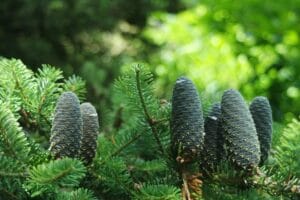
The Siberian fir is a 35 to 40 meter high tree with a diameter at breast height of up to 1 meter. It has smooth, gray or gray-brown bark with numerous resin bumps. The gray to gray-brown twigs have thin white hairs. The buds are small, hemispherical and very resinous. The needles on the upper side of the twigs are dense and point forwards.
Fir needle essential oil has many uses, especially in aromatherapy and cosmetics. Its fresh and invigorating aroma is known to create a refreshing and invigorating atmosphere. Many people use fir needle essential oil in diffusers to purify the air and provide a sense of clarity and focus.
In the field of skin care, fir needle oil is a useful ingredient in products for acne-prone or irritated skin due to its antiseptic properties. It is also often used in ointments and balms to relieve mild muscle and joint pain due to its soothing properties.
Fir needle essential oil is also often used in cleaning products, not only because of its wonderful forest scent, but also because of its natural antibacterial properties.
Aroma
Grade
Perfumery counts fir needle oils among the Heart notes.
Heart note
The scent of the heart note only appears after the top note has evaporated and lasts for 2-3 hours.
After the top note has faded, about 15 minutes after applying an essential oil to the skin, the heart note follows. Its aromas gradually unfold together with the base notes. However, the heart note determines the character of the fragrance composition. The heart note describes flowery, fruity and herbaceous notes. The middle phase usually lasts two to three hours.
You can find more interesting information on this in the article "→ World of fragrances„.
Fragrance
coniferous, spicy
Mixes well with...












Quickly find suitable etheric oil combinations.
Carrier oils



You can find a wider selection of carrier oils in the → Aromatrix
- More than 100 essential oils and carrier oils can be practically sorted -
Body, mind & soul
In the Body, Mind & Soul section, a possible therapeutic use of essential oils is described. An attempt is made to make both the Western and the Eastern perspective transparent.
The Western approach can be found under Effect and use differentiated according to body and mind & soul. For comparison, the Eastern approach describes the chakras and functional areas.
As an Aromatrix+ reader, simply read on now...
AROMATRIX - PLUS
in the practical flavor manual AROMATRIX
with comprehensive fact sheets on all oils
--- Aromatrix + oils profiles ---
Western approach
This section is written for the aroma therapy expert:
Effect
BODY
Stimulating, strongly antiseptic, also for lung complaints, promotes expectoration, deodorizing, increases circulation, soothes coughing, expectorant, pain-relieving
Mind & Soul
stimulating, invigorating
Use
BODY
Arthritis, acute bronchitis, chronic bronchitis, colds, physical exhaustion, fever, joint diseases, flu, urinary tract inflammation, cough, muscle pain, sinusitis, rheumatism, chills, tuberculosis
Mind & Soul
Tension, mental exhaustion, stress-related complaints
Eastern approach
This section is written for the TCM expert:
Pine Needle Essential Oil helps a person find the courage to overcome habitual limiting patterns and engage in new and more fulfilling situations.
5 elements
Metal element
The essential oil of pine needles is assigned to the element metal.
The element assignment of an essential oil is determined by the →Aroma profile and the direction of action. Fir needle oil has both yin and yang components. It is used as Yin in Yang because inward movements are already present in the fragrance.
Chakras
No assignment to a chakra
Essential oils without a classification listed here may also have a connection to one or more chakras. As there may not yet be a classification for the oil in question or it is too complex in its properties, it is not suitable for this systematization, as the aim of the systematization is to simplify possible applications.
A detailed explanation can be found in the following article: → Etheric oils & chakras
Functional areas
Qi deficiency
Tones and strengthens the lung qi: Bronchitis, congestion of the airways, colds and flu, asthma, cough, sinusitis
Connects the mind with the body, strengthens the psyche / instinct: weakness, asthenia, tension, stress
Main use:
pale, tired, exhausted, weak voice
Psycho-emotional representation:
hypersensitive, overanxious, antisocial, exaggerated need to correct injustice
Applications
Fir needle oil neck massage
5 ELEMENTS APPLICATION
Fir needle oil - relaxing neck massage.
Sources:
Icon by Olga from Noun Project (CC BY 3.0)
Texts are based on the following publications:
Pocket dictionary of aromatherapy by Dietrich Wabner, Verlag Systemisch Medizin, 2013
Aromatherapy with Chinese Medicine by Dennis Willmont, Willmountain Press, 2003