Who or what is the "nose"?
In the city of scents, everything revolves around the "nose".
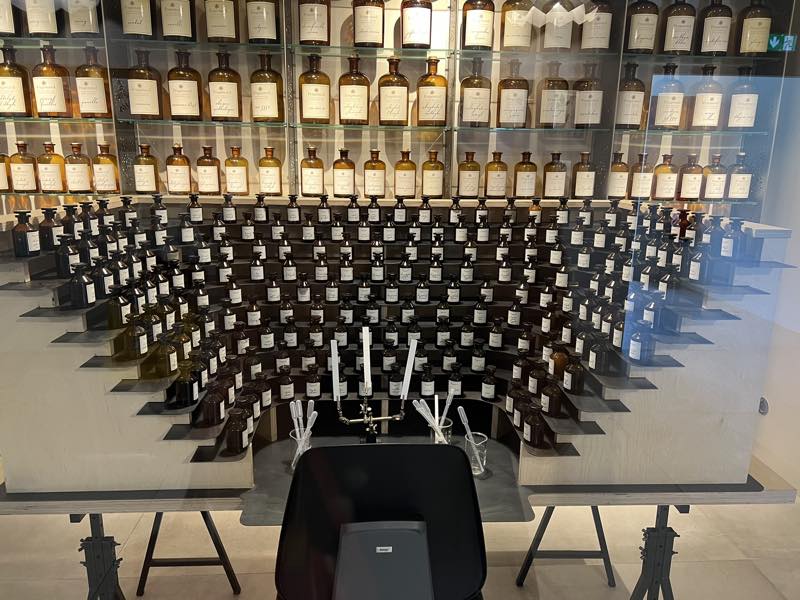
Picture workplace of a "nose".
Incidentally, "nose" is the term for a person who is able to smell and name the countless aromas and scents. This is incredibly difficult and there are only around 55 people in the world who can officially call themselves a "nose".
A budding "nose" was the leader of my course and it was fascinating to watch her smelling and correcting the many different eau de colognes we were allowed to create as a masterpiece.
What have we learned?
We analyzed the aroma profiles of "only" 9 fragrances. That sounds like child's play, but believe me, after 2 hours everything smelled somehow identical...
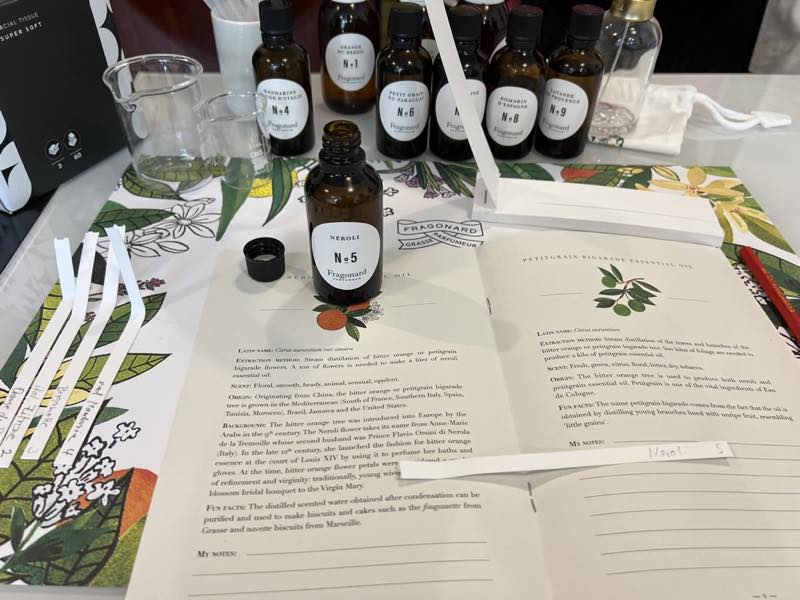
And this is precisely the art that needs to be learned. Smelling is only possible if you are highly concentrated and allow yourself to fall deeply into the fragrance. Forget everything around you, so to speak, and only feel your way into the fragrance and make the delicate fabrics around you vibrate. Only then do the subtleties, such as in different citrus fragrances, become perceptible. Fascinating!
Eau de Cologne, what is it?
The task was to create an eau de cologne. The eau de cologne was not initially invented as a fragrance, but for medicinal purposes. Essential oils were combined to support a specific indication.
Field of application of an Eau de Cologne
The best example is cologne 4711, which is known worldwide and was actually created for cleansing and care purposes. The selection of essential oils in this famous water have a vitalizing, invigorating but also calming effect. It was only when Napoleon demanded the disclosure of all ingredients of medicinal products that the company founder Wilhelm Mülhens transformed the "miracle water" into a fragrance. Among the various essential oils, the spicy rosemary with its disinfectant effect is one of the ingredients of Echt Kölnisch Wasser. Added to this is the high alcohol content of 86 % by volume, which contributes to the cleansing effect in the recipe of the scented water. This is why the Cologne original is still popular worldwide for external refreshment and as a soothing elixir.
Source: https://4711.com/pages/echt-koelnisch-wasser-gesundheit
The "Eau" and its differences
Eau de Cologne is characterized above all by its lightness and volatility, which distinguishes it from an eau de parfum. This is achieved by primarily using essential oils, which are referred to as top and heart notes in the fragrance pyramid. Top notes such as bergamot oil evaporate in just a few minutes. Heart notes such as neroli can be detected a little longer. Base notes are then also used in the perfume, which in combination and intensity make up the long-lasting fragrance.
In an Eau de Cologne, 3-5% essential oils are used.
An eau de toilette already uses 4-8% essential oils.
The Eau de Parfum, on the other hand, uses 8-15% essential oils.
The fragrance concentration also determines the durability of a fragrance. An eau de cologne is therefore more short-lived due to its low concentration of fragrance oils. However, this makes it all the more suitable for a refreshing fragrance that is not too strong or overpowering.